

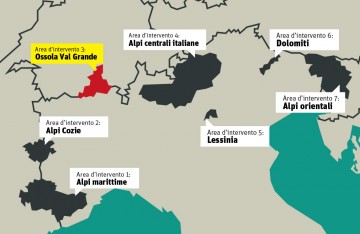
Name: Ossola Val Grande
Surface (ha): 171,128.000
Main land uses and ownership status of the project area:
The core area consists of a mosaic of land management classes, in particular 48% of the core area is protected at UE level. The surface occupied at national and regional level reaches 19% and overlaps with Natura 2000 areas. Overall, 50,6% of the core area is protected at European, national or regional level. Urbanized areas cover only 1,1% of the core area . From the beginning of the ‘900, 17 dams where build up, and hydroelectric power production has become the most important economical resource, with the metallurgical industries located in the Ossola valley bottom.
Natural features of the area:
The majority of the core area consists of mountainous areas characterized by long narrow valley bottoms surrounded by rugged mountains, with elevation ranging
from 250 to 4.634 m a.s.l. The area is between the wettest of the southern Alps. The geological peculiarity of this area is the possibility to see the lithologies and the deepest structures of the Alps chain.
The territory of the province of Verbano-Cusio-Ossola, where the core area lay, is among those with the lower human density in the Italian Alps (73 inhabitants/km2). The most important settlements are concentrated in the lowland along the river Toce, where half of the total population lives.
The high density, the variety of ungulates and generally the environmental ability, have facilitated the natural coming of species disappeared for a long time in the region, such as the wolf.
The wolf
The advent of the wolf has been made sure in 2001 when a first dispersing wolf settled in the core area for 6 years, as documented by the studies financed by the Piemonte Region in the framework of the Progetto Lupo Piemonte. Other dispersal wolves have been documented over the years, although a reproducing wolf pack did not settled yet in the area. Hence, the core area is considered as a new recolonized area, mainly interested by solitary wolves, which are the base for the formation of the first packs.
